Roofing
Roof Tear-Off Dumpster Sizing in Parker: Squares, Layers and Weight
Sizing a roof tear-off container is arithmetic, not guesswork. Squares, pitch multipliers, shingle weights, Class 4 and tile, multi-layer roofs and why a 40 yard is the wrong box.
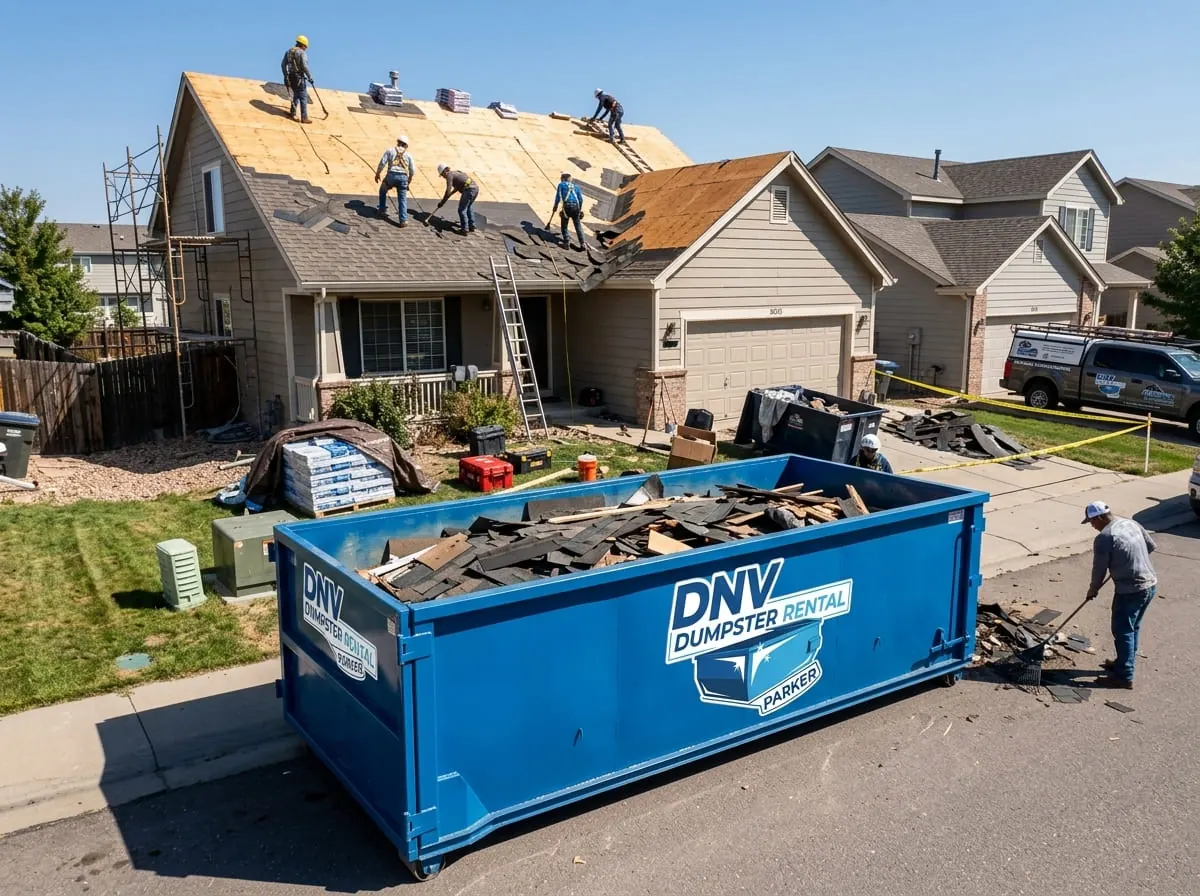
Roofing is the one job where the container decision is arithmetic, not eyeballing. A tear-off you can calculate to within a few hundred pounds before the first shingle comes loose, and doing that calculation avoids the two failures that cost real money in Parker: a can that fills at noon on day one, and a can so heavy the truck legally cannot pick it up. We have been running roofing tear-off containers across Douglas County since 2014, and it always comes down to three numbers — squares, layers and pounds per square.
The Roofing Square Is the Unit — Learn It First
A roofing square is 100 square feet of finished roof surface. Not floor area, not footprint, not a bundle count. Roofers quote in squares, shingles ship three bundles to a square on standard profiles, and every weight figure below is per square.
Estimating your own count takes two steps. First, the footprint the roof covers — outside dimensions of the house plus garage plus any covered patio or bump-out. Second, multiply by a pitch factor, because a sloped plane is always larger than the flat area beneath it. That second step is where Parker homeowners consistently under-count.
- 4/12 pitch — multiply footprint by about 1.05. A common ranch or low-slope hip.
- 6/12 pitch — about 1.12. The workhorse pitch on 1990s Parker builds.
- 8/12 pitch — about 1.20. Very common on the two-storey stock through Stonegate, Canterberry Crossing and Clarke Farms.
- 10/12 pitch — about 1.30. Steep gables, turrets, the taller elevations in The Pinery and Pradera.
- 12/12 pitch — about 1.41. Not walkable without staging, and a real tonnage multiplier.
Then add roughly ten percent for hips, valleys, dormers and cut waste. A 2,400 square foot footprint at 8/12 is not 24 squares — it is closer to 32 once pitch and waste are in. On an architectural shingle that gap is well over a ton, and it is the most common sizing mistake we hear on the phone.
Weight Per Square: Where the Real Decision Lives
Volume rarely decides a roofing container. Weight does. Tear-off debris is dense, stacks flat, and hits legal transport limits long before it hits the top rail.
- Three-tab asphalt — roughly 220 to 250 lbs per square. The builder-grade shingle on a lot of Parker's 1990s and early-2000s homes, and the lightest thing you will tear off.
- Architectural / dimensional asphalt — roughly 350 to 450 lbs per square. Laminated, two mats bonded together, so it weighs close to double a three-tab. This is what most Parker roofs have been re-covered with since the mid-2000s.
- Class 4 impact-resistant shingle — heavier again, commonly 400 to 500-plus lbs per square depending on manufacturer and profile. The extra polymer-modified asphalt and heavier mat that let it survive a hailstone also make it a heavier tear-off later.
That Class 4 line matters more here than almost anywhere in the country. After a bad cell, a large share of Parker re-roofs in impact-resistant product. So the roof torn off in 2032 will be meaningfully heavier than the one torn off this year. Size a Class 4 removal as though every square carries an extra hundred pounds over standard architectural — because it does. The claim and adjuster side of a hail replacement is a separate subject; this is purely about what leaves the roof and how it travels.
Concrete and clay tile is a different calculation entirely. Concrete tile commonly runs 900 to 1,100 lbs per square and clay sits in the same range — three to four times an architectural shingle. Even a modest tile roof is a heavy-debris job: small container, low fill line, a conversation before delivery. We treat tile the way we treat concrete and other heavy debris, and a 10 or 15 yard sitting half full is the correct outcome, not a mistake.
Multi-Layer Tear-Offs Roughly Double Your Tonnage
A second layer is the fastest way to blow a container budget. As a working rule, a two-layer tear-off runs close to double the tonnage of a single layer of the same material — a little less if a light three-tab sits under a heavier architectural, more if there is old felt, shake remnants or an added membrane down there.
Find out before you order. A roofer can lift a shingle at a rake edge or pull a vent flashing and count layers in two minutes. On Parker's newer stock the odds favour one layer, but downtown Parker and Sedalia properties, and homes that took a cheap overlay in the 1990s, do turn up doubled.
The Sizing Table
| Squares | Material / layers | Approx. tonnage | Recommended container |
|---|---|---|---|
| Up to 15 | Three-tab, single layer | 1.7 – 1.9 tons | 15 yard |
| Up to 20 | Architectural, single layer | 3.5 – 4.5 tons | 15 yard |
| 20 – 30 | Architectural, single layer | 3.5 – 6.8 tons | 20 yard |
| 20 – 30 | Class 4 impact-resistant, single layer | 4.0 – 7.5 tons | 20 yard, filled low |
| 30 – 40 | Architectural, single layer | 5.3 – 9.0 tons | 20 yard plus a swap, or two staged |
| 15 – 25 | Architectural, two layers | 5.3 – 11.0 tons | Two 15 or 20 yards, staged |
| Any size | Concrete or clay tile | ~1 ton per 2 squares | 10 or 15 yard, low fill line |
Tonnages assume clean tear-off with felt and nails, no decking replacement. Add roughly a quarter ton for every four sheets of OSB or plywood you expect to swap out.
The Rule of Thumb, Said Plainly
If you want one sentence to carry around: a 15 yard roll-off handles up to about 20 squares of single-layer shingle, a 20 yard roll-off covers 20 to 30 squares single-layer, and past 30 squares — or on any multi-layer roof — you stage two containers rather than trying to force one. Staging means the second can is scheduled before the crew starts, either sitting on site or booked for a next-morning swap, so nobody stands around at 2pm with a full box and a stripped roof.
Why a 30 or 40 Yard Is Almost Never Right for Shingle
A 30 yard or 40 yard container is a volume box, built for bulky light material — framing lumber, cabinetry, insulation, siding, a deck. Shingle is the opposite. You reach legal gross vehicle weight on the truck long before the top rail, so you pay for cubic yards you physically cannot use.
Worse, an overloaded container cannot leave. Colorado weight limits on roll-off trucks are enforced on public roads, and a driver who cannot legally carry a load will not lift it — that is a legal call, not a service one. A can loaded past limit sits in the driveway until material comes back out by hand, with an HOA compliance letter accruing while it does. The Colorado Department of Transportation regulates commercial vehicle weight statewide; limits and enforcement change, so confirm current rules.
For a roof, smaller and swapped beats bigger and stuck, every time.
Placement on a Covenanted Parker Driveway
Almost every Parker community is covenanted, and rules across Stonegate, Stroh Ranch, Idyllwilde, Cottonwood, Horse Creek and Anthology come down to the same three things: driveway only, no street or common-area placement, and a cap on how many days the container may sit. Some also want ARC notice before exterior work. Details vary by association and change over time, so confirm with your HOA or metro district — our notes on Parker permits and HOA rules cover the pattern, and any public right-of-way is a separate question for the Town of Parker.
Within the driveway, four placement rules do the work:
- Set it on the tear-off side. Crews pitch debris off the roof into the can. Every foot the container sits away from the working eave converts pitching into carrying, and carrying costs you labour hours and lands shingle on your lawn.
- Boards down, always. Douglas County's expansive bentonite clay cracks driveways long before a truck arrives. Protection boards are standard and we photograph existing condition on arrival — see how driveway protection works on delivery day.
- Clear of the garage door. You still need vehicles in and out. Set the can to one side with a walking lane, not centred across the apron.
- Off new flatwork. Fresh concrete, pavers, a new walkway, decorative stamped apron — none of it takes a loaded roll-off. Tell the dispatcher what is new before delivery, not after.
What Rides Along, and What Cannot
Everything the roof gives up rides in the same box: shingles, felt and synthetic underlayment, ice-and-water membrane, damaged decking, drip edge, step and counter flashing, pipe boots, ridge vent, turtle vents, plus gutters, downspouts and fascia if they go in the same pass. Nails, staples and sweepings count too. That is a normal mixed roofing load.
What cannot go: aerosol and liquid sealant cans, roofing cement in unopened tubs, adhesive solvents, torches and torch-down cylinders, propane bottles of any size, and anything pressurised. Colorado also bans electronics from landfill disposal, PaintCare handles leftover architectural paint, and Douglas County runs household chemical roundups for the rest — Douglas County publishes current dates. Disposal rules do shift, so check before you assume. And on any pre-1990 structure — the older downtown Parker, Sedalia and Louviers properties — asbestos-containing material is a real possibility and CDPHE Regulation No. 8 inspection rules apply. We cannot accept asbestos in any container. Our page on what can and cannot go in a dumpster in Douglas County has the full list.
Timing: Hail Season Runs the Calendar
From May through September, one cell off the Palmer Divide puts several hundred Douglas County roofs into the queue in an afternoon, and every roofer in the county wants a container the same week. That is the practical reason contractor accounts and standing next-morning delivery matter here — after a storm, the crews with a relationship get steel and the ones cold-calling wait. If you are a homeowner caught in that window, book the can when you sign the contract, not when the crew shows up. Our same-day and next-day delivery exists mostly because of this season.
The weather also shapes the working day. At 5,800 feet the UV is punishing and shingle heats fast, so crews start at first light and want tear-off down before the afternoon builds. Front Range thunderstorms fire early afternoon with real reliability in July and August, so an open deck at 2pm is a gamble — dry-in happens before the sky turns. Have the container in place the evening before, not mid-morning of day one.
On large or multi-layer roofs, build a mid-job swap into the schedule from the start. A full can at 11am on a 40-square tear-off stops a six-man crew cold; a swap booked in advance keeps them working. Next-day swap-outs are routine, and on storm weeks they are the difference between a two-day roof and a four-day roof.
Finish With a Magnet
Skipping this is how you end up buying tires. Roll a magnetic sweeper over the whole driveway, the apron, the street gutter line and every landscape bed on the tear-off side — twice, in crossing directions. A tear-off drops thousands of nails and plenty bounce further than you would guess. Good crews do it unasked; ask anyway, and walk it yourself before the container leaves.
Get the Size Right Before the First Shingle Moves
Tell us your footprint, your pitch, your shingle type and how many layers you think are up there, and we will tell you what to put in the driveway — and whether you need one or two. DNV Dumpster Rental Parker has hauled tear-off out of Parker, Douglas County and the south-east metro since 2014: flat-rate pricing, protection boards standard, next-day swap-outs and contractor accounts for roofers who cannot wait after a storm. Call (720) 674-7845 or get in touch with our Parker team and we will size it with you in five minutes.
Questions this guide did not answer? Call (720) 674-7845. We would rather spend two minutes on the phone than have you order the wrong container.