
Hail & Insurance
Hail Damage to New Roof in Parker: The Whole Sequence, Start to Finish
The full sequence a Parker homeowner faces after a hail cell: spotting real damage, filing the claim, vetting roofers, Colorado's deductible law, HOA approval, and exactly where the tear-off container fits.
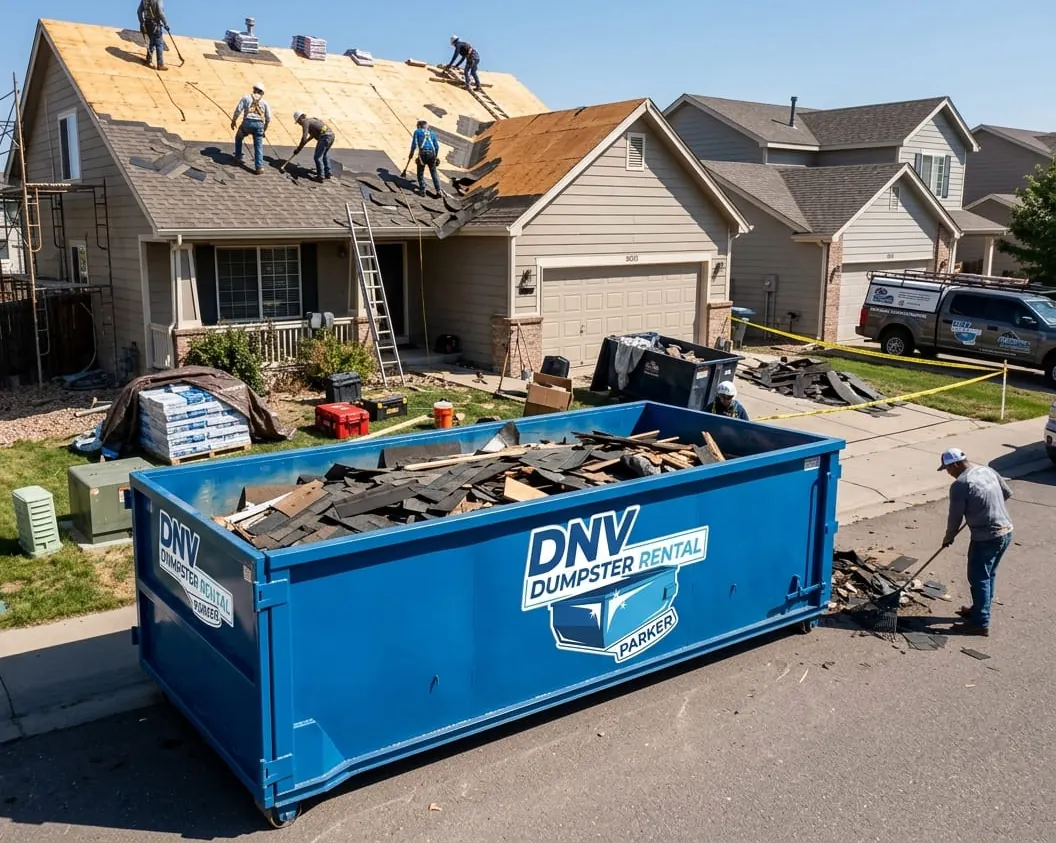
A hail cell off the Palmer Divide can be over your subdivision in six minutes and gone in twelve. Then the sun comes out, the street dries, and it looks like nothing happened. That is the problem. We have hauled tear-off out of Stonegate, Canterberry Crossing, Clarke Farms and The Pinery since 2014, and the pattern repeats: the storm is short, the paperwork is long, and the homeowners who come out cleanest knew the sequence in advance. Here it is, in order.
What Hail Actually Does to an Asphalt Roof
An asphalt shingle is a fibreglass mat saturated in asphalt with ceramic granules on top. The granules are not decoration, they are the sunscreen. Along the Front Range we get thin air, brutal UV and a freeze-thaw cycle that swings through both extremes in a February day. Strip the granules and the asphalt underneath starts cooking.
Functional damage shows up three ways. Bruising is a soft spot you feel more than see — press it with a thumb and it gives, like a bruise on an apple, because the mat behind it is crushed. Granule loss leaves a dark shiny circle of exposed asphalt with a pockmark centre. Mat fracture is the real failure: the fibreglass has split, and that shingle is a water path whether or not it leaks this month.
Cosmetic marking — install scuffs, manufacturing blisters, algae streaks, satellite-installer foot traffic — is none of that, and a good adjuster tells the difference in ninety seconds.
Why You Cannot Tell From the Ground
Honest answer: you usually cannot. Bruising is close to invisible from the driveway, and from a ladder at the eave you see the least-hit plane of the roof. What you can read are the soft targets, and they beat the shingles for reliability:
- Window screens — dented, torn or pushed out of frame. They tell the truth about stone size.
- Gutters and downspouts — dimples on the top face of a gutter, dents on the flat of a downspout.
- AC condenser fins — the aluminium fin pack flattens on the impact side, giving you storm direction.
- Deck and fence boards — soft cedar pockmarks long before a shingle shows anything. Painted metal too: garage doors, vents, flue caps.
If the screens and the AC fins are hit, the roof was hit. That is your trigger to get somebody up there.
The Claim Sequence
Do these in order, and document before you talk to anyone selling anything:
- Nail down the date. Carriers work from a date of loss. If a second storm rolls through weeks later, you want your evidence timestamped to the right one.
- Photograph everything, wide and close. Screens, gutters, downspouts, AC fins, deck and fence boards, garage door, vents. Phone photos carry a timestamp — that is the point.
- Photograph what is already broken. Douglas County sits on expansive bentonite clay and most driveways here have a crack map before any truck arrives. Document the driveway and apron so nobody argues later about who cracked what.
- Call your carrier and open the claim. Ask how your wind-and-hail deductible is calculated — some Colorado policies carry a percentage-of-dwelling deductible rather than a flat one.
- Get an adjuster on the roof, with your roofer present.
- Read the scope line by line. Check it covers underlayment, ice-and-water at eaves and valleys, drip edge, pipe boots, ridge vent and flashing — not just shingle.
The Colorado Division of Insurance publishes consumer guidance on homeowner claims and takes complaints. Read it before the adjuster appointment, not after.
Vetting a Roofer After a Storm
A serious hail event pulls crews from four states into Parker inside a week. Some are good. Some are a magnetic sign on a rented pickup and a plan to be gone by October — a problem when the warranty needs honouring in year three.
- A local address with history. Not a PO box or a mail-drop suite. Somewhere you could drive to.
- Licensing and permitting. Colorado issues no statewide roofing licence; it is local, so the contractor must be licensed in the right jurisdiction — the Town of Parker in town, Douglas County for unincorporated property. That boundary is not always where people assume.
- Liability and workers' compensation certificates sent direct from the insurer, not a PDF forwarded by the salesman.
- References inside your own subdivision — not "in Colorado." Ideally last season, so you can see how it wintered.
- A written contract with scope, materials, approximate dates and cost, the contractor's physical address and phone, and refund terms.
Be wary of the door-knocker offering to "handle everything" — he negotiates the claim, you sign over the proceeds and never see the scope. You are the policyholder. Read every document your name goes on.
The Deductible Is Not Negotiable, and That Is the Law
This matters more than anything else on the page. Under C.R.S. 6-22-105, a roofing contractor doing residential work paid from property and casualty insurance proceeds may not advertise or promise to pay, waive or rebate all or part of your insurance deductible. Not by "eating it," not by a rebate, not by a phantom invoice line that quietly covers it.
So when a salesman offers to cover your deductible as a favour, hear what he is telling you: he will break a consumer-protection statute in front of a stranger on day one. That is a preview, not generosity. The same statute requires the contract to disclose the deductible restriction and your rescission rights, and requires the contractor to hold your payment in trust until materials are delivered.
On rescission: Colorado gives you seventy-two hours after written notice that the insurer denied the claim in whole or in part to rescind the contract, in writing, to the contractor's contract address. He then has ten days to return payments and deposits, less the reasonable value of work performed.
Plain caveat: this is general guidance from a hauler, not legal or insurance advice. Statutes get amended and policy language varies. Confirm current requirements with the Division of Insurance, your carrier and, where real money is at stake, an attorney.
ACV, RCV and the Cheque That Comes Later
On a replacement-cost policy the carrier typically issues the first payment at actual cash value — the depreciated value of the roof — minus your deductible. That is not the whole settlement. The recoverable depreciation is the balance, released after the work is finished and the final invoice is submitted. So the first cheque looks too small; that is normal, not a denial. If your policy is actual cash value only, there is no second cheque at all — know that before you plan the scope.
The HOA Layer Nobody Expects
This is where Parker differs from the rest of the metro, and it is the most avoidable mistake we see. Nearly every community here is covenanted — Stonegate, Idyllwilde, Stroh Ranch, Pradera, Cottonwood, Horse Creek — and many covenants require Architectural Review Committee approval of shingle colour and profile even on a like-for-like insurance replacement. Several have narrowed their approved palettes since the homes were built, so the shingle on your roof today may no longer be approvable.
Your property may sit inside a metro district and an HOA, with separate rules on how many days a container may sit and where — usually driveway-only. Get the ARC submittal in while the adjuster is still scheduling; it runs in parallel and costs nothing. Doing a roof twice because the committee rejected the colour is a miserable summer. Our guide to dumpster permits and HOA rules in Parker covers the container side. Rules vary and change, so read your covenants and ask your manager in writing.
Class 4 Impact-Resistant Shingle
Most Parker homeowners ask about Class 4 after a bad season, a fair question in a hail corridor. Class 4 carries the top impact rating under the standard steel-ball drop test, and many carriers offer a premium credit for it — ask yours in writing before you commit, because the credit varies by company and is not automatic. Two notes: Class 4 is not hail-proof, it is impact-resistant, and a big enough stone still marks it. And it is heavier per square, which matters for sizing when a heavier-class roof is the one coming off. Size by weight, not looks.
Where the Container Fits
Late. Deliberately late. The container is ordered once the scope is agreed and the crew has a start date — not the week of the storm, when nobody knows whether the claim is approved or how many squares come off.
Sizing is by squares and layers, not the footprint of your house. A square is 100 square feet of roof surface, and a second layer roughly doubles the tonnage. Heavy laminate weighs more per square than old three-tab. Most single-layer Parker tear-offs land on a 20 yard roll-off; larger homes, steeper pitches or two layers move to a 30 yard container, and a small ranch can be fine in a 15 yard. Full arithmetic is in our tear-off dumpster size guide.
Placement is a conversation with the roofing foreman before delivery, not after. The box goes on the tear-off side, so shingles come off the roof into steel instead of being carried around the house by hand. Protection boards are standard on our roofing dumpster rentals — on cracked Douglas County clay that matters. More on protecting a driveway during delivery.
| Stage | What you do | What we do |
|---|---|---|
| Storm night | Record the date. Photograph screens, gutters, AC fins, deck and fence boards, driveway cracks. | Nothing yet. Do not order a container. |
| Days 1–10 | Open the claim, ask how your wind-and-hail deductible is calculated, and vet roofers on address, licensing, insurance and subdivision references. | Answer sizing questions by phone. |
| Adjuster and scope | Meet the adjuster with your roofer present, then read the scope line by line. | Stand by. |
| HOA / ARC | Submit shingle colour and profile. Check placement rules and day limits. | Advise on placement that satisfies driveway-only rules. |
| Contract signed | Confirm crew start date. Note your 72-hour rescission rights. | Hold a delivery slot for the day before tear-off. |
| Delivery | Clear the driveway the night before. Confirm the tear-off side. | Deliver, lay boards, position for the roof face being stripped. |
| Tear-off | Stay out of the drop zone. | Next-day swap-out if the roof outruns the box. |
| Completion | Magnet the drive, lawn, beds and street. Submit the final invoice for depreciation. | Haul out before your HOA day limit expires. |
Timing, and the Last Hour
After a big cell, every roofer in Douglas County wants a container the same seven days. Give us the crew start date the moment you have it, even provisionally. We run same-day and next-day delivery and next-day swap-outs from Dransfeldt Road — coverage is on our service areas page. Call Tuesday for a Wednesday crew in peak season and you are competing with fifty others.
Then the nails. A tear-off sheds thousands into lawn, beds, gravel and street, and they end up in tyres and dog paws. A good crew runs a rolling magnet before leaving; run one yourself afterwards anyway, twice, in perpendicular passes. Felt, old flashing and bent pipe boots ride out with the shingles — our Douglas County construction debris guide covers what separates out.
Ready When Your Crew Is
Thirteen years in and the advice does not change: document early, vet hard, get ARC approval moving in parallel, and let the container be the last piece rather than the first. When you have a start date, call DNV Dumpster Rental Parker at (720) 674-7845. We will match the box to your squares and layers, lay boards on the drive and be gone before your HOA counts days. Or reach us through our contact page.
Questions this guide did not answer? Call (720) 674-7845. We would rather spend two minutes on the phone than have you order the wrong container.