Delivery
Protecting Your Driveway When a Dumpster Is Delivered in Parker
What really happens mechanically when a roll-off is dropped and hooked, why Douglas County clay already cracked your driveway, and the prep that keeps a Parker delivery clean.
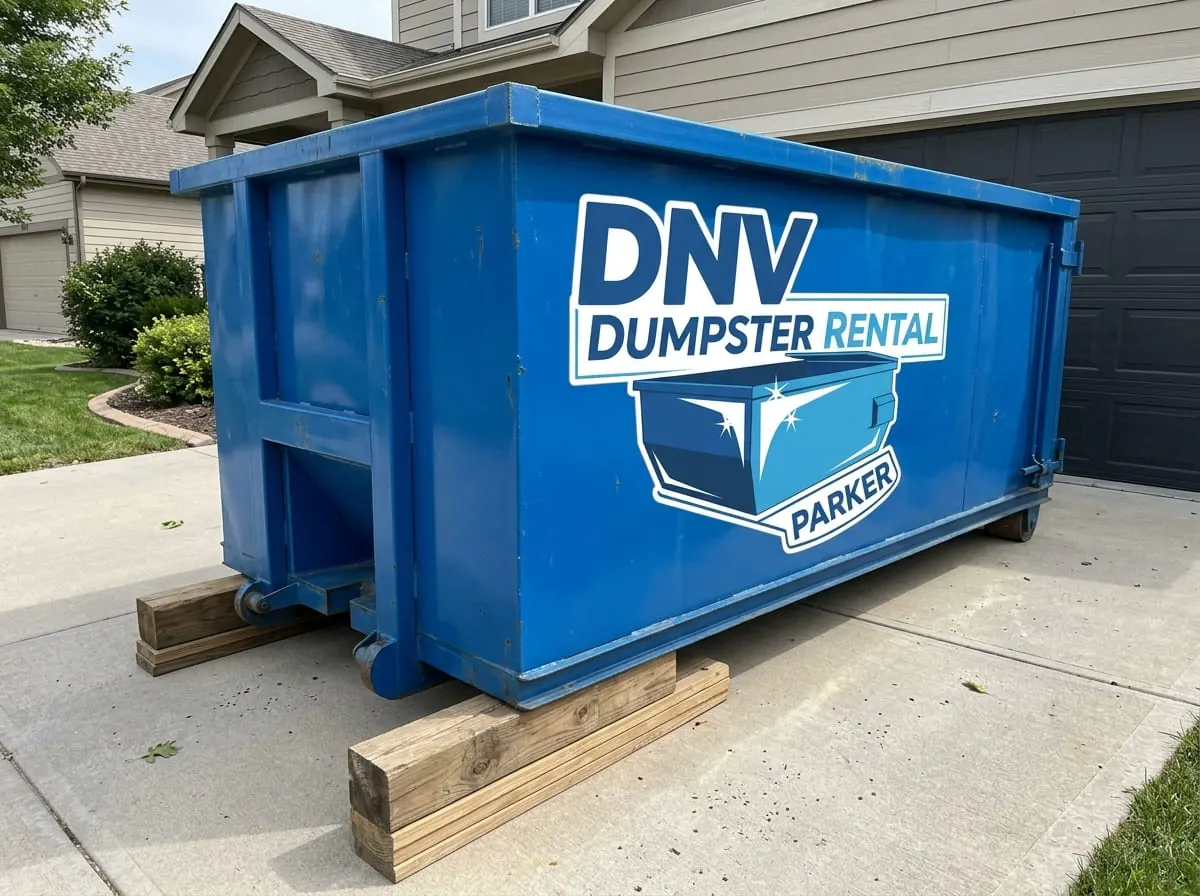
Almost every call we get about driveway damage comes after the fact, and almost every one could have been a two-minute conversation before the truck rolled. So here it is: what physically happens when a roll-off is set down and picked back up, why Douglas County dirt changes the answer, and what you can do the morning of delivery.
We have been running cans in Parker since 2014. Protection boards go under every residential drop as standard — not an upsell, not on request. That is the baseline.
What actually happens when a roll-off is delivered
People picture a dumpster being lowered gently onto the driveway. That is not what happens. A roll-off container comes off a hoist truck, and the sequence is specific.
- The driver reverses down the driveway on a straight line, because the box has to land where he can get it back.
- The hoist raises the bed steep enough that the rear of the container touches ground while the front is still 15 or more feet in the air.
- The cable pays out and the container rolls down the rails on two small steel wheels at the rear. For a few seconds the entire empty weight of that box — a couple of tons on the bigger sizes — rides on two narrow steel contact patches, turning under load.
- As it comes fully off the truck, the front drops the last short distance and the two long steel rails on the underside settle. Now the load spreads across the rails, but the rail ends carry the concentrated point load.
Pickup runs the same movie backwards, except the container is full. The cable drags it up onto the rails and those same steel wheels roll over your surface under real weight. Which is why the two moments that matter are the drop and the hook, not the days in between. A container sitting still does far less to a driveway than the ten seconds it took to put it there.
Protection boards go under the wheel path and the rail ends. They spread the point load over square feet instead of square inches, and on asphalt they keep hot steel off softened surface. That is most of the battle.
The Douglas County complication: expansive clay
Parker sits on expansive bentonite clay. It takes on water and swells, dries and shrinks, and it runs that cycle every year under every driveway, garage slab and patio in town. It is why so many Parker homes have structural floor systems and void form under the basement walls, and why cracking in flatwork is ordinary enough here that builders plan for it.
Practically: most driveways we back onto across Parker and Douglas County already have hairline cracking, settlement at a control joint, or a lifted panel at the garage apron — long before any truck arrives. Heave from wet clay can lift a panel the better part of an inch. No hoist truck does that; the soil did, over years.
So we photograph the existing condition on arrival — the approach, the set-down area, any cracking already there, time-stamped. That is not us building a defence; it protects both sides and ends the argument before it starts. Most of the time the crack was already there and nobody had looked that closely. On the rare occasion it was us, the photos prove that too, and we handle it.
Surface by surface
| Surface | Main risk | What we do | What you should do |
|---|---|---|---|
| Concrete | Point-load cracking at the rail ends, spalling on older slabs, existing clay-heave cracks widening | Boards under wheels and rails, set-down centred on a panel rather than a control joint, photos on arrival | Tell us the age of the pour and point out any panel that rocks or sounds hollow underfoot |
| Asphalt | Gouging and indentation in heat, sealcoat scuffing and pickup, rutting in the wheel path | Full board coverage, morning delivery in summer, a controlled roll-off | Book the earliest slot you can from May through September, and say if it was sealcoated this season |
| Pavers | Units rotating, sinking or chipping, sand base displacing, edge restraint failing at the perimeter | Wide board spread across many units, and an honest conversation about placing elsewhere | Consider the street or a gravel pad instead — pavers are the surface we most often advise against |
| Gravel or road base | Rutting, wheels digging in, the container settling out of level, poor traction on the pull-out | Boards to spread the rails, a level check before set-down, and we refuse soft ground | On acreage, walk the drive after rain or snowmelt and warn us if it is soft; flag septic tank and leach field |
New concrete deserves its own paragraph
Flatwork is a different animal from a footing — thin, exposed, and sitting on that same clay. Our rule is simple: a fresh pour does not take a loaded container for a good while after it goes down — weeks, not days. If your driveway or apron is newly poured, say so when you book. We will put the can on the street where covenants allow, on a gravel staging area, or on an older section of drive — we are not going to be the ones who cracked your new slab.
Altitude, UV and the summer asphalt problem
Parker sits above 5,800 feet and the UV load up here is well above what asphalt sees at sea level. That, plus long clear afternoons, softens sealcoat and the binder in the top layer noticeably in high summer. Press a bootheel into a south-facing asphalt drive at three in the afternoon in July and you will feel it give. Then set steel wheels on it.
The fix is scheduling, not equipment. We push asphalt drops to the morning from roughly May through September, before the surface has taken half a day of sun. If you have asphalt and you are booking a roofing tear-off container in a hot stretch, ask for the first run of the day.
Winter: snow, sheet ice and frozen ground
- Packed snow or ice on the approach. A hoist truck reversing on ice goes where physics wants, not where the driver aims. If your drive is glazed, clear it and put down traction material.
- Ice under the set-down point. Set a container on ice and it settles unevenly when the ice melts — and it can slide. We will not do it. We would rather come back a day later than put a loaded can on a sheet of ice on a sloped Parker driveway.
- Frozen ground on gravel. Frozen ground carries weight beautifully; the same ground thawing in afternoon sun is a rut factory. On acreage with long gravel drives, morning delivery and morning pickup is usually right in winter.
What the truck actually needs
- About 60 feet of straight, clear approach. The truck needs runway to line up and back down. A tight curve or a car parked halfway along kills it.
- Roughly 10 feet of width — not 10 feet of driveway with a landscape boulder at eight, but genuine clearance mirror to mirror.
- Around 23 feet of overhead clearance while the hoist is up. This is the one that catches people: the bed goes a long way into the air during the roll-off, so a low service drop, a mature pine limb or decorative trim over the garage door is in the way even though the truck itself fits under fine.
Overhead lines are the usual surprise in older parts of downtown Parker and on acreage lots where the drop runs from a pole across the driveway. Tell us and we will place at the top of the drive instead. If your project involves digging, call 811 through Colorado 811 first.
The Parker placement problem: covenants and gate codes
In most markets, if the driveway is tricky you put the container on the street. In Parker that is often off the table. Nearly every community here is covenanted — Stonegate, The Pinery, Canterberry Crossing, Clarke Farms, Stroh Ranch, Idyllwilde, Cottonwood, Pradera, Anthology, Horse Creek — and driveway-only placement is a very common term, along with a cap on how many days the can may sit. Some properties answer to both an HOA and a metro district, which means two rulebooks.
That flips the calculation. If your covenants say driveway only, driveway protection is not a nice-to-have, it is the plan. It also makes size matter more: a smaller can on a flat section of drive beats a big one straddling a joint or hanging over the apron. Our Parker sizing guide and the full range of container sizes are worth a look first: a 15 yard with a shorter footprint often solves a problem a 30 would create. We cover covenants in depth in our guide to dumpster permits and HOA rules in Parker. Rules change and every association writes its own, so confirm the current version with your HOA or metro district before scheduling; if the container would touch public right-of-way, check with the Town of Parker or Douglas County depending on who maintains your street.
One more Parker specific: gated communities. The driver needs the gate code or call-box name at booking, not at 7:40am from the entry lane. A five-second detail that regularly costs an hour.
Ten minutes of prep before delivery
- Move every vehicle out of the driveway, including the one in the garage if you will need it later — the container may block the door. Move bins, planters and anything else out of the approach path.
- Flag irrigation heads and shallow valve boxes along the driveway edge. Heads at the apron are the most commonly damaged thing on a residential drop and are invisible from a truck cab.
- On acreage, flag the septic tank lid and the leach field clearly. A loaded container belongs over neither.
- Clear the basketball goal — portable base or pole-mounted, both live right where the hoist wants to be.
- Tell us about a new pour, soft ground, fresh sealcoat, a low line, or a panel you already know is bad.
- Have the gate code ready, and say which way the doors should face.
How you load it changes what it does to your driveway
A container loaded evenly transfers weight through the rails the way it was designed to. Pile it all at one end and you concentrate load and make the pickup drag harder.
- Heavy material first, spread flat across the floor — never stacked in one corner.
- Keep the weight low. Bulk and light material on top.
- Do not load above the top rail. An overfilled container cannot be tarped and cannot legally leave.
- Keep concrete, dirt, brick and other heavy debris in a small dedicated can. That is what the 10 yard exists for, and it is the best way to keep total weight sane on your driveway.
Mixed residential cleanout loads are rarely a weight problem. Tear-off shingles, tile and masonry are.
If you do see damage
Call us the same day, before anything gets washed, swept or repaired. Take photos in daylight from several angles with something in frame for scale. We will pull our arrival photos and compare. Because we photograph every residential drop, it is a short conversation. What we will not do is argue about a crack neither of us documented — which is the whole reason the process exists.
Talk to us before delivery, not after
If your driveway is new, steep, pavered, freshly sealcoated, gated, or covered by covenants that leave you no option but the driveway, tell us when you book. Protection boards are standard, arrival photos are standard, and if the ground is not right on the day we will say so instead of setting a can down and hoping. Call DNV Dumpster Rental Parker at (720) 674-7845 or get in touch through our contact page to talk placement, and ask about same-day and next-day delivery across Parker, Douglas County and the south-east metro.
Questions this guide did not answer? Call (720) 674-7845. We would rather spend two minutes on the phone than have you order the wrong container.