Construction
Construction and Renovation Debris in Douglas County: A Contractor's Playbook
A working playbook for builders, remodelers and GCs in Douglas County: what debris actually weighs, how to sequence containers by phase, and the asbestos and covenant rules that catch out-of-area contractors.
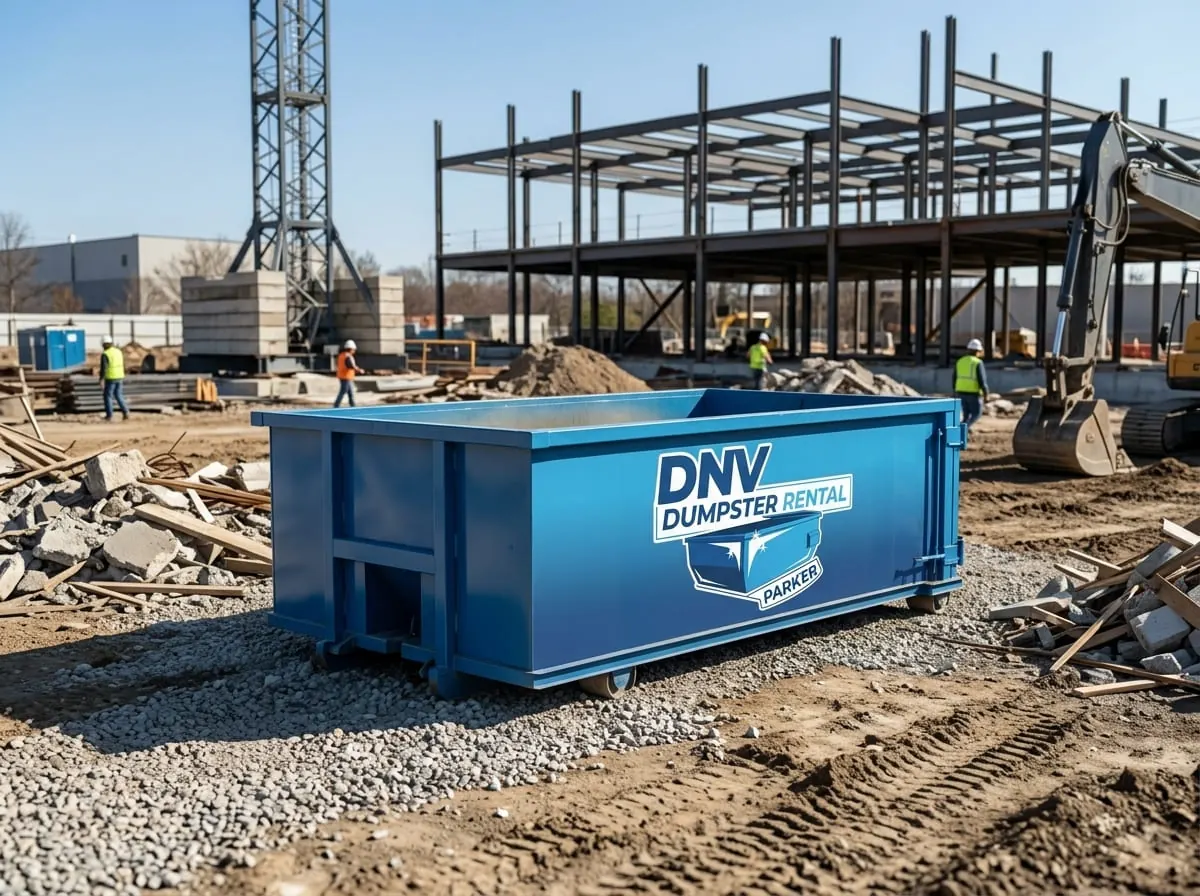
Every general contractor working Douglas County runs the same math: how much material is coming out, how heavy it is, where it can legally go, and how many times the container has to turn before the crew stands around a full box. Get that wrong and disposal becomes the least controlled line item on the job.
We have set roll-offs on Parker jobsites since 2014 — new-build lots in Anthology and Idyllwilde, scrape-and-rebuild work off Mainstreet, basement finishes in Stonegate, barn work toward Franktown. This is the operational side of construction dumpster rental in Parker: what debris weighs, how to sequence containers, and the two local rules that catch out-of-area contractors.
C&D debris is not municipal solid waste
Construction and demolition debris is a separate category from household trash. C&D is the inert and structural stream: concrete, brick, block, asphalt, lumber, engineered wood, drywall, roofing, siding, window and door units, flooring, cabinetry, insulation, packaging. Municipal solid waste is what comes out of a kitchen bin.
They go to different facilities on different pricing logic. Most C&D tips by weight at a facility set up to sort and recover it — clean concrete and asphalt are crushed to aggregate rather than buried, clean wood is ground, scrap metal has its own market. That is why a dedicated clean load of concrete and heavy debris is handled differently from a mixed builder's box, which loses that recovery value.
The practical rule: keep the construction container construction-only. The minute crews throw lunch bags or a homeowner's garage contents into the builder's box, the load reclassifies. If the homeowner needs a clearout too, that is a separate container.
The Douglas County growth context
Parker, Castle Rock, Lone Tree and the CO-86 Founders Parkway corridor sit among the fastest-growing residential markets in Colorado, and that produces a construction profile you do not see in older parts of the metro. Three types of work run simultaneously, often on the same streets:
- New build. Framing scrap, engineered lumber offcuts, housewrap, sheathing, drywall scrap, and enormous volumes of packaging from appliances, cabinets, tile and fixtures.
- Scrape-and-rebuild. Older parcels near downtown Parker and out through Sedalia and Louviers where the land is worth more than the structure. Full demolition debris, foundation concrete, and the asbestos question below.
- First-refresh remodel. The 1990s and 2000s subdivisions have hit twenty-five and thirty years — builder-grade kitchens and baths, decks at end of life, basement finishes, roofs. This is the volume work in Parker right now.
For a GC the container plan changes completely between a Canterberry Crossing kitchen gut and a Sedalia teardown, even though both read as "one dumpster" in the estimate.
What the material actually weighs
The most expensive mistake in this trade is loading dense inert material into a large container. Volume and weight are unrelated problems. A 40 yard holds four times the volume of a 10, but no container may exceed legal axle weight, and a 40 full of concrete cannot be lifted safely or legally.
| Material | Unit | Typical weight | What it means on site |
|---|---|---|---|
| Asphalt shingles, 3-tab | 1 square (100 sq ft) | ~230–250 lb | Weight-driven, not volume-driven |
| Asphalt shingles, architectural | 1 square | ~330–430 lb | Count layers before sizing |
| Concrete or asphalt, broken | 1 cubic yard | ~3,500–4,000 lb | Dedicated 10 yard, loaded flat |
| Brick and block | 1 cubic yard | ~3,000–3,500 lb | Same rule as concrete |
| Ceramic tile with mortar bed | 1 cubic yard | ~2,500–3,000 lb | Heavier than it looks |
| Sod with soil attached | 1 cubic yard | ~2,000–2,500 lb | Wet sod nears dirt; keep separate |
| Landscape rock and cobble | 1 cubic yard | ~2,400–2,800 lb | Common on xeriscape tear-outs |
| Drywall, demolished | 1 cubic yard | ~500 lb | Moderate weight, high volume |
| Drywall sheet, 1/2 in. | 4x8 sheet | ~50–55 lb | 5/8 in. runs closer to 70 lb |
| Framing lumber, loose | 1 cubic yard | ~300–400 lb | Bulky-light; what a 40 is for |
| Cabinetry, millwork, trim | 1 cubic yard | ~200–300 lb | Fills volume fast, adds little weight |
| Mixed C&D, average | 1 cubic yard | ~350–500 lb | Use for rough remodel planning |
Read that as two container classes. Anything above roughly 2,000 lb per yard belongs in a dedicated 10 yard dumpster — concrete, brick, tile, sod, rock, dirt. Low walls, easy to load by wheelbarrow, and it reaches legal weight long before it looks full.
The 40 yard roll-off is the opposite tool: a bulky-light container for framing scrap, siding, cabinetry, decking, insulation and packaging. Right box for a framing or finish phase, wrong box for anything you can barely lift with two hands. In between, a 20 yard handles most single-room remodels and a 30 covers whole-house interior demo.
Sequence containers by phase instead of oversizing
Out-of-area GCs tend to order one big box for the whole job and leave it. On a tight Douglas County infill lot that is the worst option available: it eats your only staging space, sits half-empty for two weeks, then fills in three days and stalls the trades.
- Demo. Heaviest and dirtiest. Flatwork, foundation or tile goes in a dedicated small box; everything else — drywall, flooring, old cabinetry — in a mid-size container.
- Framing and rough. High volume, low density. Lumber offcuts, sheathing scrap, housewrap, duct and pipe cutoffs. Big box, swapped when full.
- Finish and punch. Packaging dominates — appliance cartons, cabinet crates, tile and fixture boxes — plus trim scrap and floor covering. Volume again, almost no weight.
Between phases, use next-day swap-outs rather than a permanently oversized container. A swap keeps one footprint on the lot, keeps the box right-sized for the phase, and stops you paying to store air. Same-day and next-day service is what makes phased sequencing workable rather than theoretical.
CDPHE Regulation No. 8 and the demolition permit
Colorado Air Quality Control Commission Regulation No. 8, Part B, requires an asbestos inspection by a Colorado-certified building inspector before renovation or demolition disturbing more than the trigger amounts — broadly 260 linear feet on pipes, 160 square feet on other surfaces, or a 55-gallon drum equivalent. On any structure of unknown age, assume inspection is required until an inspector says otherwise.
In Parker's newer subdivisions this is usually a short conversation. On downtown Parker Mainstreet buildings, Sedalia, Louviers and rural farmhouse work it is very much live — popcorn ceilings, vinyl floor tile and mastic, pipe wrap, transite siding, joint compound. Most jurisdictions here gate the demolition permit on that report, so a missing inspection does not just create a disposal problem, it stops the job before it starts.
We cannot accept asbestos-containing material in any container, at any size. That work goes to a licensed abatement contractor and a permitted disposal route. Requirements change and enforcement varies by jurisdiction, so confirm current thresholds with CDPHE and your permit desk at the Town of Parker before scheduling demo.
The HOA and metro-district layer
This is the one that catches contractors from outside the county. Nearly every Parker community is covenanted — Stonegate, The Pinery, Canterberry Crossing, Clarke Farms, Stroh Ranch, Idyllwilde, Cottonwood, Pradera, Anthology, Horse Creek — and a property can sit under both an HOA and a metro district with separate rules.
- A cap on how many consecutive days a container may sit, often measured in days rather than weeks.
- Driveway-only placement. No street, no common area, no greenbelt, no guest parking.
- ARC design-review approval before exterior work — roofing colour, siding, decks, fences, windows.
- Delivery and work-hour windows, sometimes with advance notice to the management company.
Put the covenant check in your pre-construction checklist next to the permit, not after mobilisation. The violation letter lands on the homeowner, and the homeowner calls you. Our guide to dumpster permits and HOA rules in Parker covers the detail. Covenants get amended, so read the current recorded documents for that community, not last year's version.
Jobsite logistics specific to this county
Infill and scrape lots in older Parker are tight, with utilities close and neighbours closer. On new construction, flatwork gets poured before the finish trades arrive and then everything heavy drives over it — protection boards go under rails and wheels as standard on our deliveries. Read the detail on driveway protection during delivery before promising a homeowner an unmarked slab.
Expansive bentonite clay does the rest of the damage on its own; Douglas County driveways heave and crack long before a truck arrives, so photograph existing condition at mobilisation. That habit settles more disputes than anything else we do. On acreage work toward Franktown, Elizabeth and Kiowa the constraints change again: long gravel drives that soften after a storm, septic tanks and leach fields flagged before a loaded truck crosses them, wells and buried waterers. Call Colorado 811 for public utilities and have the owner mark private lines, because 811 does not locate them.
Separate the stream and cut the tipping cost
Source separation is the cheapest lever a GC controls. Four streams are worth pulling out on any job of size:
- Scrap metal. Ductwork, copper, conduit, appliances, steel studs and corral panels on ranch work.
- Clean wood. Untreated dimensional lumber and pallets — no paint, no laminate.
- Cardboard. On a finish phase this is a third of your volume. Breaking it down is free.
- Clean concrete, brick and block. No rebar tails, no dirt, no trash. Crushed to aggregate rather than landfilled.
Contamination kills recovery value, so if a stream will be mixed anyway, order a mixed box and load it properly. Our overview of recycling and disposal in Douglas County covers where each goes.
Colorado landfill restrictions that show up on jobsites
- Electronics. Colorado bans TVs, monitors and computers from landfill disposal. Basement finishes and tenant-improvement work produce them constantly.
- Tires, lead-acid batteries and used oil. Each has its own recycling route, and all turn up on acreage and shop demolition.
- Paint. Leftover architectural paint goes through PaintCare drop-off sites, not the container.
- Solvents, adhesives, pool chemicals and fuel. County household chemical roundups handle the residential side; commercial quantities need a waste vendor.
The full accepted-and-prohibited list is in what can go in a dumpster in Douglas County. Rules change, so confirm current restrictions with the county before building a disposal plan around them.
Scheduling around hail season and winter
Front Range hail runs roughly May through September and Parker takes it hard. One cell over Stonegate or Canterberry can put every roofer in the county on the phone the same morning, and container availability across the south metro tightens within hours. If roofing is in your scope during those months, book early rather than on the day, and check the load math in our roofing tear-off size guide. Tear-off is a weight problem, not a volume problem.
Winter flips the constraints. Frozen ground carries a truck better than spring mud but makes dirt and sod removal miserable. Snow and ice on a sloped driveway change where a container can safely be set and released, and a box left through a storm can freeze its load solid. Plan swaps around weather windows.
Standing accounts, COIs and one invoice
If you run more than a couple of jobs at a time, stop ordering one-off. A standing account with a hauler who knows your sites means the dispatcher already has your placement notes, protection-board requirement and site contact. We are licensed and insured and issue certificates of insurance where GCs and property managers need them on file before mobilisation, and we consolidate invoicing across active jobs so your bookkeeper reconciles one statement instead of a stack of tickets. Flat-rate pricing matters more here than anywhere else: a variable disposal line is the one an estimator cannot bid confidently.
DNV Dumpster Rental Parker has run containers for builders, remodelers and GCs across Parker, Castle Rock, Lone Tree and Douglas County since 2014. Owner Dane Novak will walk your scope, tell you which sizes you need and in what order, and get the first box on site on your schedule. Call (720) 674-7845 or get in touch to set up a contractor account.
Questions this guide did not answer? Call (720) 674-7845. We would rather spend two minutes on the phone than have you order the wrong container.