Estate Cleanouts
Clearing a Family Home in Parker: A Practical, Unhurried Checklist
A respectful, practical order of operations for clearing a family home in Parker: the paper sweep that comes first, the room-by-room sequence, HOA container rules and realistic timelines.
There is no hurry. Whatever anyone tells you about listing the house or the family flying in, a home that took forty years to fill does not have to be emptied in a weekend. We have handled estate cleanouts around Parker and Douglas County since 2014, and the jobs that go badly are almost always the ones that started fast.
So here is the first rule, and it matters more than everything else in this guide combined: do not throw anything away on day one. Day one is for looking. Not sorting, not hauling, not filling a container that is sitting in the driveway making everyone feel like the clock is running. Look first. Everything else waits.
Sweep the whole house for paper before a single box moves
Walk every room, closet and drawer with one job only: find the legal and financial material. Do this while the house is still intact, because once boxes move, context disappears and a folder that made sense in a desk drawer becomes an anonymous stack in the garage. What you are hunting for:
- The will, any codicils, and any trust documents
- Deeds to real property, plus title insurance policies and closing packets
- Vehicle titles, including for trailers, boats, RVs, tractors and ATVs
- Insurance policies of every kind, plus any annuity contracts
- Tax returns going back several years and any IRS or state correspondence
- Savings bonds, stock certificates, CD receipts and old passbooks
- Safe-deposit keys, and any note of which bank and branch
- Military discharge papers, the DD-214 especially, which affects burial and survivor benefits
- Birth and marriage certificates, divorce decrees, Social Security cards, passports
- Pension, 401(k) and IRA statements, and anything naming a beneficiary
And one specific to this state that gets binned constantly: mineral rights and water rights documentation. Colorado families hold severed mineral interests they have not thought about in thirty years, sometimes on land sold long ago. Well permits, augmentation plans, ditch shares and decreed water rights are real, transferable assets, and they live in shoeboxes and unmarked envelopes. We have watched a crew nearly tip a box of mineral deeds into a container because it looked like junk mail. Set aside anything carrying a legal description, a section-township-range reference, a royalty statement or state engineer letterhead, and let the attorney sort it out.
Valuables hide in stupid places, and that is not a joke
People who lived through lean years did not trust banks the way you do. Cash and jewellery turn up taped under drawers, in the lining of coat pockets, in the freezer wrapped in foil and labelled as leftovers, inside hollowed books, behind picture frames and in coffee cans up in the garage rafters. Check every coat pocket before it goes to donation. Empty every purse. Look under drawers, not just in them. Open every freezer container before it hits the curb.
Firearms, ammunition and medications
Firearms are common in Colorado households and turn up more often than families expect, usually in closets and under beds rather than in a safe. Nothing with a firing pin or a primer goes in a roll-off container. Not the gun, not loose ammunition, not the old reloading powder in the garage. Contact the Douglas County Sheriff's non-emergency line for guidance on surrender or transfer, or take them to a licensed dealer who can handle transfer, appraisal or consignment properly. If the personal representative means to distribute them, the attorney should confirm how transfer works for those beneficiaries. Treat every firearm as loaded.
Medications are the other one. Do not flush them and do not put them in a container. Douglas County and several Parker-area pharmacies host permanent take-back drop boxes, and sharps need their own container. Drop-box locations change, so check with Douglas County first.
Confirm who has authority before anything is disposed of
This is the part families skip and later regret. Until someone is formally appointed, no one has legal standing to dispose of estate assets, and a well-meaning sibling who cleared the garage can create a genuine problem. Douglas County probate runs through the district court in Castle Rock, and the personal representative is appointed there. Before anything of value leaves the property, that person should speak with the estate attorney and get clear on what may be discarded, what must be inventoried and appraised, and what needs beneficiary sign-off. In practice the paper sweep and the authority conversation run in parallel, and clearing starts after. Procedures change, so confirm the current process with the court or your attorney rather than with a cousin's experience in another county.
The room-by-room sequence that actually works
Start with the least emotional room, almost always the garage, a spare bedroom or unfinished basement storage. Build rhythm on paint cans and camping gear before anyone opens a wardrobe. Never start in the primary bedroom or the home office. The bedroom is where grief lives and the office is where the important paper lives, and both need slow hands.
| Room | Search first | Usually goes | Set aside |
|---|---|---|---|
| Garage / shed | Rafters, coffee cans, tool chest drawers | Broken tools, scrap lumber, old tyres, patio junk | Vehicle and trailer titles, cash tins, good hand tools, scrap metal |
| Spare bedroom | Closet shelf boxes, under the bed, dresser undersides | Mattresses, dated bedding, damaged furniture | Photo boxes, letters, coin jars, anything with a name on it |
| Basement storage | File boxes, filing cabinets, shelving totes | Water-damaged cardboard, exercise equipment | Tax returns, deeds, mineral and water documents, military papers |
| Kitchen | Freezer contents, canisters, drawer bottoms, cookbook pages | Expired food, worn cookware, plasticware | Silver and flatware sets, cast iron, china, cash in tins and books |
| Living and dining | Behind picture frames, inside book jackets, sofa cushions | Worn upholstery, particle-board furniture, media | Art, framed photographs, records, anything signed |
| Hall closets | Every coat pocket, hat boxes, shoe boxes | Worn outerwear, broken luggage, old linens | Cash and jewellery in pockets, safe-deposit keys |
| Home office | Desk drawer undersides, safe, locked cabinets, binders | Obsolete media, dead printers, paper after review | Will, titles, policies, bonds, stock certificates, DD-214 |
| Primary bedroom | Nightstands, jewellery boxes, closet shelves, mattress edges | Clothing after review, bedding, worn furniture | Jewellery, watches, letters, medications for take-back |
Four piles, and being honest about what family will take
Every room gets sorted into four piles and nothing else: keep, sell, donate, dispose. No "decide later" pile, because that one becomes a second cleanout in six months. If an item truly needs a decision from someone who is not there, photograph it, label it and stage it in one marked corner with a deadline attached.
Families also overestimate what they will take by a wide margin. Everyone says they want the dining set. Almost nobody has room for it. Give people a real window to claim items, ask them to put it in writing, then hold that line. A dining set sitting in a garage for a year waiting on a nephew in Fort Collins is not being preserved, it is being stored at the cost of the whole project.
Donation, consignment and the honest word on furniture
Good clothing, working small appliances, kitchenware, books and linens move well through local donation channels, and several will collect a full load. Genuine antiques, mid-century pieces, jewellery, coins, stamps and quality tools deserve an appraisal or consignment conversation first. But be ready for this: most furniture has very little resale value. Large dark-wood bedroom sets, entertainment centres, china cabinets, sectionals and anything particle-board are effectively unsellable, and many charities decline them. That is the market, not a reflection on the family. Once you accept it the project moves twice as fast, and an estate cleanout service in Parker or a scheduled junk removal pickup becomes the sane answer for the remainder.
The Parker practicalities
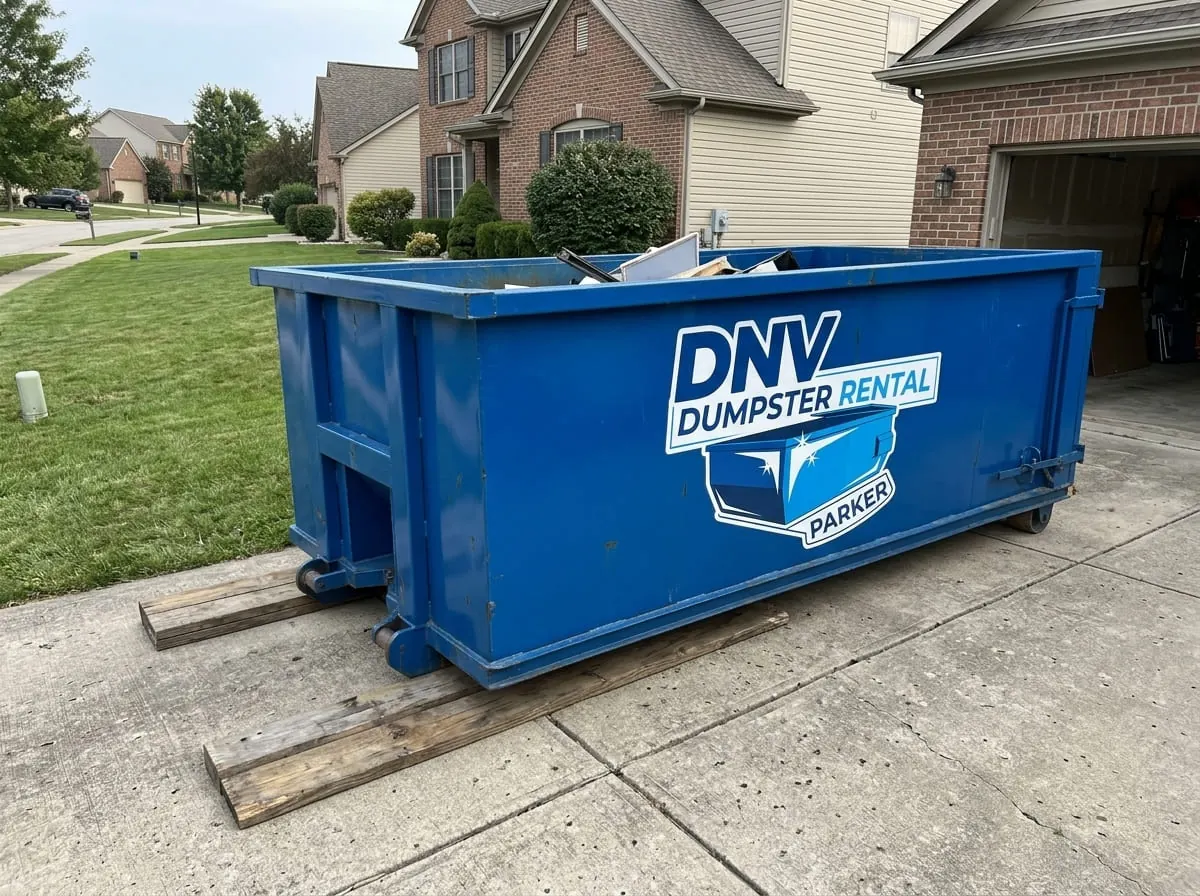
This is where local knowledge saves you a letter in the mailbox. Nearly every Parker community is covenanted, and Stonegate, The Pinery, Canterberry Crossing, Clarke Farms, Stroh Ranch, Idyllwilde, Cottonwood, Pradera, Anthology and Horse Creek all carry rules that touch this job. The two that bite hardest are a cap on how many days a container may sit and a requirement that it stay on the driveway rather than the street. Some properties sit under both an HOA and a metro district. Read the covenant before you book anything, and if the cap is tight, tell us up front so we can plan the swap or the pull around it. Our guide to dumpster permits and HOA rules in Parker goes deeper, and rules change, so confirm the current version with your association or the Town of Parker.
Book the window generously. An estate is not a kitchen remodel with a known end date, and asking for extra days up front is far easier than begging for an extension on day six. Driveways here take a beating from expansive bentonite clay and freeze-thaw long before a truck arrives, so protection boards are standard and we photograph existing condition on arrival, as covered in our notes on protecting a driveway during delivery.
Sizing an estate cleanout
A typical Parker home of this era, meaning a 1990s to 2010s two-storey with a finished or partly finished basement, fills a 30 yard roll-off. That is the honest default. The alternative that often works better on a covenanted driveway is a 20 yard container with one swap, because a 20 has a lower profile, sits more comfortably in a standard driveway and keeps the footprint modest for the neighbours. Either way, a swap-out is normally cheaper than having two containers on site at once, and next-day swaps mean you are rarely waiting. If you are unsure, our dumpster size guide for Parker walks through the maths, and our containers run from 10 through 40 yards if the house is larger or smaller than the norm.
What cannot go in the container
Colorado bans electronics from landfill disposal, so televisions, monitors, computers, printers and most powered devices need an e-waste route. Leftover architectural paint goes to a PaintCare drop-off, and household chemicals, solvents, pesticides, pool chemicals and automotive fluids go to the Douglas County chemical roundup. Refrigerant appliances, meaning refrigerators, freezers, window air conditioners and dehumidifiers, need certified recovery first. Tyres, batteries, propane cylinders and anything asbestos-containing are also out, and older properties in downtown Parker, Sedalia or Louviers may need a Colorado-certified inspection under CDPHE rules. Our breakdown of what can go in a dumpster in Douglas County and the local recycling and disposal options cover the routes. Accepted lists change, so confirm before driving across town.
A realistic timeline, and permission to take longer
Four people working full days will clear a typical Parker house in three to five days. Not a weekend, and not one person. One person alone, working evenings and Saturdays, is looking at three to four weeks, which is fine if the house is not under contract. Build in a rest day. Estate work is physically ordinary and emotionally exhausting, and tired people on day four are exactly when the irreplaceable things get thrown out. If you need a second week, take it. The same order of operations suits a straightforward move-out, covered in our home cleanout checklist.
Discretion
A roll-off in the driveway announces something to the whole street, and not every family wants that. If it helps, we schedule early collection so the container is gone before the neighbourhood is properly awake, and we keep placement tight and tidy in the meantime. It costs nothing to ask. We work throughout Parker, Douglas County and the south-east Denver metro, across the areas we serve.
When you are ready, or if you just want to talk through sizing and timing before the family arrives, call DNV Dumpster Rental Parker at (720) 674-7845. Dane and the crew have worked these homes since 2014, we can hold a delivery window while you work through the paper, and next-day swaps mean the container never sets your pace. You can also reach us through our contact page.
Questions this guide did not answer? Call (720) 674-7845. We would rather spend two minutes on the phone than have you order the wrong container.